
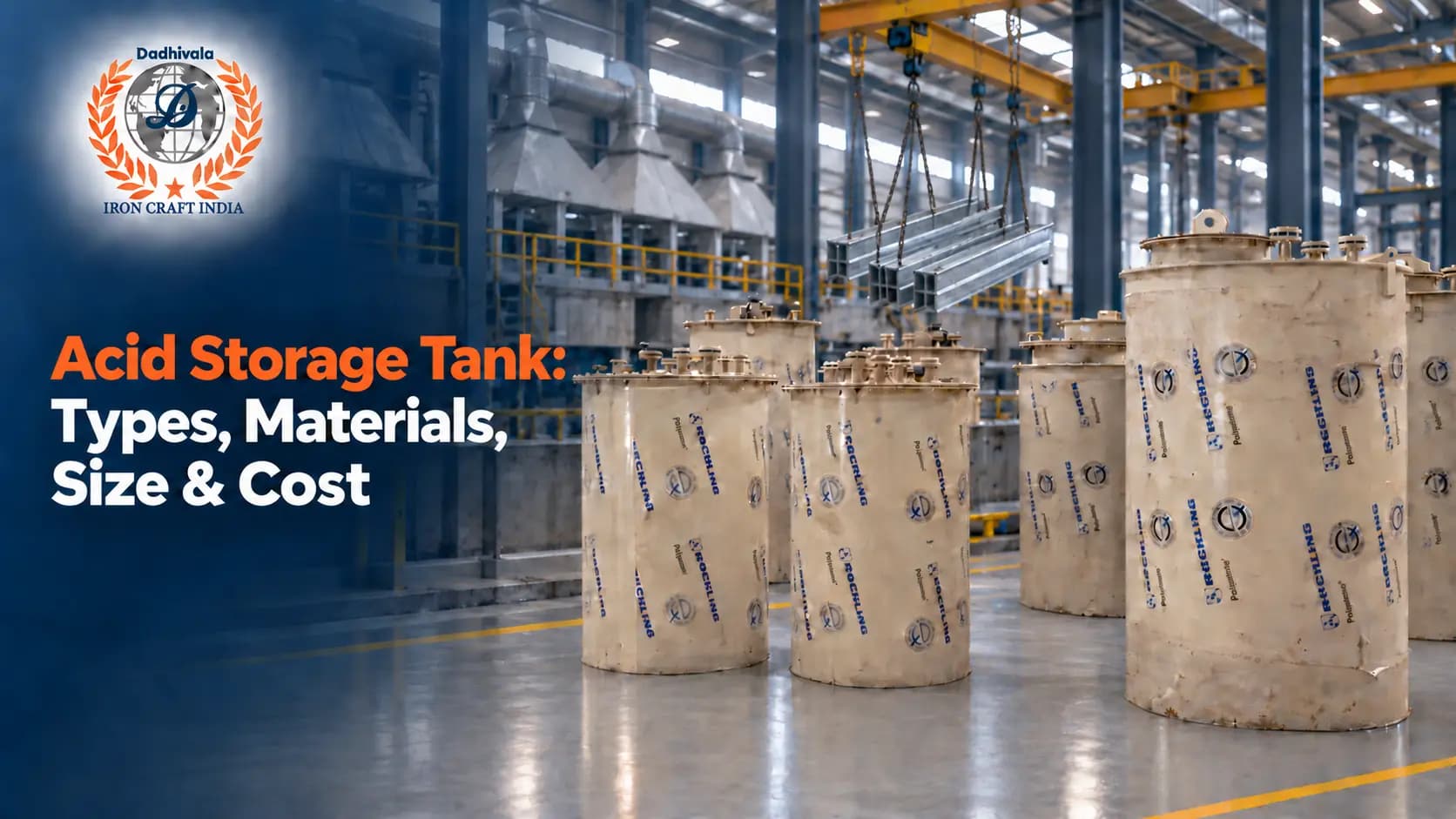
Choosing an acid storage tank looks simple until something goes wrong. A tank that is fine for dilute hydrochloric acid can fail within months on concentrated sulfuric, and a tank without proper containment can turn a small leak into a shutdown.
The right tank balances four things over a 10-20 year life: corrosion risk, regulatory compliance, total cost and reliable operation. In short:
- Material: match it to the exact acid, concentration and temperature, not just the acid name.
- Size: one full delivery plus safety stock, divided by a 90% maximum fill level.
- Safety: secondary containment of at least 110% of the largest tank, correct venting and high-level alarms.
- Cost: compare cost per year of service life, not the purchase price.
Why Acid Storage Tanks Need Special Design
How acid tanks actually fail
- General corrosion: the acid dissolves metal and thins the wall, as with carbon steel in hydrochloric acid.
- Pitting and chloride attack: chlorides break down the passive film on stainless steel, ruling out 304 and 316 for hydrochloric acid.
- Oxidation: concentrated nitric acid and other oxidizers degrade many plastics, resins and rubbers.
- Hydrogen grooving: in steel sulfuric acid tanks, rising hydrogen bubbles can cut vertical grooves near nozzles.
- Permeation and stress cracking: some chemicals migrate into or embrittle plastic walls, especially when hot or around stressed fittings.
Acids are also heavy. Concentrated sulfuric acid weighs about 1.84 times as much as water, so a tank designed for water can be under-built for acid even when the material is compatible.
Regulatory drivers around the world
- United States: OSHA requires quick-drench and eyewash facilities wherever workers can be exposed to corrosives. Fire codes (IFC, NFPA 400) cover corrosive liquids. Note that the EPA SPCC rule, often quoted for acid tanks, actually applies to oil.
- UK and Europe: COSHH risk assessment, EN 12573 for welded thermoplastic tanks, EN 13121 for GRP tanks and, for large inventories, Seveso III.
- India: State Pollution Control Board consents, the Factories Act 1948 and hazardous waste rules for spent acid.
Common Acids and Their Storage Challenges
| Acid | Typical Commercial Strength | Approx. Specific Gravity | Main Storage Challenge |
|---|---|---|---|
| Sulfuric (H₂SO₄) | 93–98% | 1.83–1.84 | Very heavy; absorbs moisture; becomes far more corrosive to steel when diluted |
| Hydrochloric (HCl) | 30–36% | 1.15–1.18 | Releases corrosive HCl fumes; attacks almost all common metals |
| Nitric (HNO₃) | 55–68% | 1.35–1.41 | Strong oxidizer; degrades many plastics, resins and rubber at high strength |
| Phosphoric (H₃PO₄) | 75–85% | 1.58–1.69 | Heavy; wet-process grades carry fluoride and chloride impurities |
| Hydrofluoric (HF) | 40–70% | ~1.15 (48%) | Attacks glass and glass fiber; extremely toxic on skin contact |
| Acetic (glacial) | ~99% | 1.05 | Flammable (flash point ~39 °C); solvent action on some plastics |
Sulfuric acid is concentration-dependent. At 93–98%, it forms a protective iron sulfate film on carbon steel, which is why steel tanks are standard for concentrated grades. Once moisture dilutes the acid, that protection disappears and corrosion accelerates sharply. The material that is correct at 98% is often wrong at 50%.
Hydrochloric acid is a vapor problem as much as a liquid problem. Commercial 32–36% HCl gives off hydrogen chloride gas that corrodes structures and electrical panels well beyond the tank, so design must handle the vent stream, not just the liquid.
Tank Materials: What Works for Which Acid?
Thermoplastics: HDPE, XLPE and PP
Thermoplastic tanks dominate hydrochloric acid and dilute acid storage because they do not corrode the way metals do. HDPE and cross-linked polyethylene (XLPE) are usually rotomolded in standard sizes. A welded polypropylene tank made from sheet can be built to custom dimensions and handles higher temperatures than polyethylene. The limits are strong oxidizers (concentrated nitric and sulfuric acid), temperature and UV exposure outdoors. Design is governed by DVS 2205 and EN 12573 for welded tanks and ASTM D1998 for polyethylene upright tanks.
FRP / GRP with acid-specific resins
Fiber-reinforced plastic tanks suit large capacities and higher temperatures. Performance depends on the resin and inner corrosion barrier: vinyl ester for aggressive service, isophthalic polyester for milder duty. For hydrofluoric acid and fluoride-bearing acids, a synthetic veil must replace glass in the corrosion barrier, because HF attacks glass fiber. Relevant standards include ASTM D3299, ASTM D4097, EN 13121 and ASME RTP-1.
Carbon steel
Carbon steel is acceptable for concentrated (typically 93–98%) sulfuric acid at ambient temperature, usually built to API 650. It needs a desiccant breather to keep moist air out, low nozzle velocities and regular wall-thickness checks. It is not suitable for hydrochloric, nitric or dilute sulfuric acid.
Stainless, alloys and lined steel
304L is the traditional choice for nitric acid, 316L handles phosphoric and many organic acids, and Alloy 20 was developed for intermediate-strength sulfuric acid. None suit hydrochloric acid. Rubber-lined steel is common for large hydrochloric acid tanks but needs periodic relining. Glass-lined steel serves high-purity duty but is fragile and cannot handle hydrofluoric acid.
Quick compatibility guide
| Material | HCl (≤36%) | H₂SO₄ Dilute | H₂SO₄ 93–98% | Nitric Acid |
|---|---|---|---|---|
| HDPE / XLPE | Good | Good | Only with a resin rated by the maker | Dilute only |
| Polypropylene (PP) | Good | Good | Not recommended | Dilute only |
| FRP (vinyl ester) | Good | Good | Not recommended | Limited, low strength |
| Carbon steel | No | No | Good (ambient) | No |
| Stainless 304L / 316L | No | Limited | Limited | Good |
| Rubber-lined steel | Good | Good | No | No |
General guide at ambient temperature only. Always verify against the manufacturer’s chemical resistance data for your exact concentration, temperature and impurities.
Sizing Acid Storage Tanks Correctly
Start with delivery size and consumption
The most common mistake is sizing for consumption and forgetting how the acid arrives. The tank must accept a full delivery while still holding stock until the next one. A quick rule is 1.5 times the delivery volume; a more precise method is:
Nominal capacity = (Delivery volume + Daily usage × Lead-time days) ÷ Maximum fill fraction
Use a maximum fill of about 90% for most acids and 85% for fuming acids, leaving room for expansion and the air surge at the end of pneumatic unloading.
Worked example: A plant uses 1,200 L of 33% hydrochloric acid per day, receives 15,000 L deliveries and needs 5 days of reorder cover. (15,000 + 1,200 × 5) ÷ 0.90 = 23,333 L, so specify a 25,000 L (about 6,600 US gal) tank.
Specific gravity drives wall thickness
Liquid pressure at the base of a tank rises with both liquid height and specific gravity. At 5 m depth, water exerts about 0.49 bar. Sulfuric acid at 1.84 SG exerts about 0.90 bar, roughly 84% more load on the same wall. Thermoplastic codes also apply reduction factors for temperature and chemical exposure.
Always give your fabricator the design specific gravity, the maximum operating temperature and the exact chemical. A quotation “for 25,000 L” without these three values is not comparable to any other quotation.
Layout: access, unloading and feed
- Allow tanker access with a short unloading line and a fill point inside the containment area.
- Gravity feed saves pumps but needs elevated tanks and stronger supports; pumped feed gives more freedom in tank location.
- Separate incompatible chemicals. Keep acids away from alkalis, hypochlorite and cyanides, and nitric acid away from organics.
Safety and Compliance Essentials
Secondary containment
Treat containment as part of the tank, not an accessory. A bund or dike should hold at least 110% of the largest tank volume, a widely used benchmark across codes and insurers. It needs an acid-resistant lining and no open drain valve. Double-wall tanks with leak monitoring suit tight spaces. When buying bulk acid storage tanks, ask for bunding to be quoted alongside the tank so that both are sized to the same design.
Venting, fume scrubbing and vapor control
Size vents for the maximum fill rate plus the unloading air surge, and for draw-off so the tank never pulls a vacuum. Fuming acids such as hydrochloric should vent through a wet acid fume scrubber, while concentrated sulfuric acid tanks need a desiccant breather. Overflows should discharge inside containment through a liquid seal.
Level monitoring, leak detection and isolation
- A level gauge or transmitter readable from the fill point, with a high-level alarm the unloading driver can hear.
- A close-coupled isolation valve on every bottom outlet, and flexible connectors on plastic tanks to keep pipe loads off the nozzles.
- Emergency showers and eyewash stations within a few seconds’ walk, to ANSI/ISEA Z358.1 or equivalent.
- Clear labeling at the tank and fill point, so the wrong chemical cannot be offloaded.
Inspection regime
Combine routine visual checks with a documented inspection at least once a year: crazing, bulging and weld cracks on plastic tanks; blistering and exposed fibers on FRP; ultrasonic wall thickness and nozzle grooving on steel. Record findings so deterioration can be tracked as a trend.
Cost Breakdown: Upfront vs Lifecycle
Prices vary widely by region, capacity and specification, but the relative position of each material stays consistent:
| Material | Relative Upfront Cost | What Limits Service Life | Maintenance Load |
|---|---|---|---|
| HDPE / XLPE | Low | UV, oxidation, temperature | Low; visual checks |
| Polypropylene (welded) | Low–Medium | Weld quality, temperature | Low; weld inspection |
| FRP / GRP | Medium | Corrosion barrier condition | Moderate; internal inspection |
| Carbon steel (conc. H₂SO₄) | Medium | Wall loss, grooving | Moderate; thickness surveys |
| Rubber-lined steel | Medium–High | Liner ageing | Periodic relining |
| Stainless / alloys | High | Usually long where compatible | Low |
The tank is only part of the budget
Foundations, containment, scrubber or breather, instruments, piping, the unloading station and installation often cost as much as the tank itself. Compare complete installed systems, not bare tanks.
Building a TCO model for approval
Leadership approves lifecycle numbers more readily than purchase prices. A simple model:
Annual cost = (Tank + Installation and ancillaries + Maintenance over life + Relining or repairs) ÷ Expected service years
Illustration in index units: Option A costs 100 for the tank and 80 for installation, needs 3 per year of maintenance and lasts 12 years. That works out to (180 + 36) ÷ 12 = 18 per year. Option B costs 170 for the tank and the same 80 for installation, needs 2 per year and lasts 25 years: (250 + 50) ÷ 25 = 12 per year. The “expensive” option is a third cheaper to own.
Real-World Selection Examples
The two scenarios below are illustrative, showing how the decision logic is applied.
Example 1: 40,000 L tank for 98% sulfuric acid
At 98%, polypropylene and standard FRP are ruled out, and polyethylene works only with a resin rated for this service. Carbon steel is the usual answer: designed for 1.84 SG, with a desiccant breather, a 110% bund and annual thickness surveys.
Example 2: Hydrochloric acid for a steel pickling line
Galvanizing and steel finishing plants typically store 30–33% hydrochloric acid and dilute it for use in their pickling tanks. Polypropylene or vinyl ester FRP suits the service, venting into the pickling bay scrubber, with fresh and spent acid tanks in a common lined bund. For plants being set up as a new galvanizing line, plan the acid area this way from the first layout drawing.
Checklist: Specifying Your Acid Storage Tank
- Chemical: acid type, exact concentration, known impurities and design specific gravity.
- Temperature: minimum and maximum liquid and ambient temperature; indoor or outdoor installation.
- Capacity: delivery volume and method, daily usage, lead time and maximum fill level.
- Material and code: shortlisted materials, verified compatibility data and the design standard to be followed.
- Configuration: vertical or horizontal, footprint and height limits, nozzle sizes and positions, and manway access.
- Safety systems: containment volume and lining, vent or scrubber, level instruments and alarms.
- Documentation: design calculation, material certificates, weld or laminate test records and a leak test report.
- Vendor: references in the same acid service, warranty and after-sales support.
Frequently Asked Questions
Can an acid storage tank be switched to a different acid later?
Not without a fresh engineering review. Plastic and FRP walls absorb small amounts of the stored chemical over years of service, and those traces can contaminate or react with the new acid. If a change is unavoidable, drain, neutralize, rinse and inspect the tank, then get written confirmation from the manufacturer that both the material and the original design suit the new acid before refilling.
Should acid storage tanks be installed indoors or outdoors?
Both work if the design accounts for the location. Outdoor plastic tanks need UV-stabilized material or shading. In cold climates, 98% sulfuric acid can freeze at roughly 0–3 °C, while the 93% grade stays liquid far below that, so grade selection, insulation or heat tracing matter. Indoor tanks need ventilation to stop fumes building up.
What is the difference between a bulk acid storage tank and a day tank?
A bulk storage tank receives tanker deliveries and holds days or weeks of stock, usually in a dedicated acid yard. A day tank is a much smaller tank placed near the process and filled from the bulk tank by pump, holding roughly one shift or one day of usage. It keeps large acid volumes off the production floor, makes consumption easy to meter, and limits how much acid can escape if a process line fails.
Can a leaking acid tank be repaired?
Often, yes, but the method depends on the material. Polypropylene and HDPE tanks can usually be repaired by extrusion welding, while rotomolded XLPE generally cannot be welded. FRP can be repaired by grinding back and relaminating, and rubber-lined steel is patched or relined. Always drain and neutralize first, and fix the root cause or the repair will fail again.