
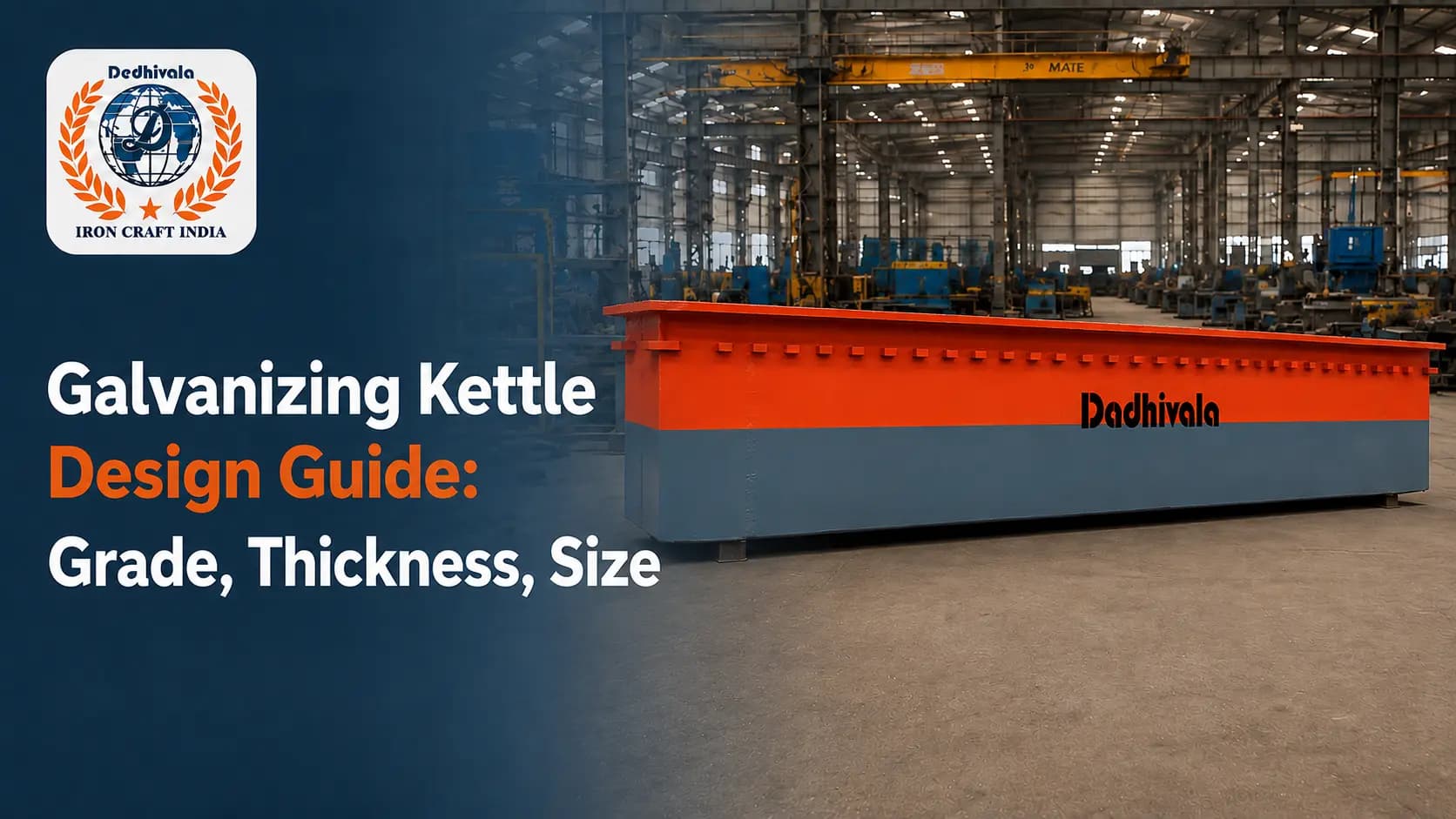
A galvanizing kettle is a welded rectangular tank that holds molten zinc at about 445-465 °C. Good design comes down to three things: the right steel (low-silicon, low-carbon boiler-quality plate), the correct wall thickness (typically 40-60 mm depending on kettle size and heating method), and accurate sizing (internal length × width × depth matched to your longest product plus adequate freeboard). Get these right and a kettle commonly lasts 8-12 years; get them wrong and premature wall erosion or bulging can end its life in a few years.
The galvanizing kettle - also called the zinc bath or zinc tank - is the single most important component of any hot-dip galvanizing plant. It holds tonnes of molten zinc, absorbs constant thermal load, and slowly gets eaten away from the inside by the very reaction that makes galvanizing work. Because a replacement kettle means days of downtime and a large zinc handling exercise, its design decides both your coating quality and your long-term running cost. This guide breaks kettle design into the three factors that matter most: steel grade, wall thickness, and sizing.
1. Boiler Plate Grade: Why the Steel Matters More Than Anything
A galvanizing kettle is fabricated from boiler-quality steel plate - not ordinary structural (mild) steel. Boiler plate is made to tighter chemistry and cleanliness limits so it can handle sustained high temperature without cracking or distorting. But for a zinc bath there is one extra rule that overrides everything else: the steel must be low in silicon.
The Silicon Problem (The Sandelin Effect)
Molten zinc attacks steel by forming iron-zinc alloy layers - the same reaction that bonds zinc to your product also slowly dissolves the kettle wall. Silicon dramatically accelerates this reaction. A steel with the wrong silicon content can corrode several times faster, thinning the wall from the inside and shortening kettle life.
This is why reputable kettle makers insist on special low-silicon, aluminium-killed steel rather than whatever plate is cheapest.
Typical Chemistry Targets for Kettle Steel
| Element | Typical Target | Why It Matters |
|---|---|---|
| Silicon (Si) | As low as possible (often < 0.03-0.04%) | The #1 factor. High silicon = fast wall erosion. |
| Carbon (C) | Low (≈ 0.10% max) | Keeps steel tough and weldable at high temperature. |
| Phosphorus (P) | Low | Also speeds up zinc attack if too high. |
| Deoxidation | Aluminium-killed | Clean, consistent steel that resists molten-zinc attack. |
Common boiler / pressure-vessel plate designations such as ASME SA516, DIN 17155 (HII) or equivalent IS grades are used as a starting point, but the key is that the plate meets the low-silicon galvanizing-kettle specification.
Many manufacturers source purpose-made “galvanizing kettle steel” for exactly this reason. Always confirm the mill certificate and silicon content before fabrication; the grade on paper matters far less than the actual chemistry.
2. Wall Thickness: Buying Years of Service Life
Because the kettle is slowly consumed from the inside, wall thickness is effectively a service-life budget. Thicker walls give more sacrificial steel and more resistance to bulging under the weight and heat of the zinc - but they also cost more, heat up more slowly and add weight.
Design is about choosing the right thickness for the kettle size and heating method, not simply the thickest plate available.
Typical Thickness Ranges
| Kettle Size / Duty | Typical Wall Thickness | Notes |
|---|---|---|
| Small kettles | ~ 40 mm | Lighter zinc load, faster heat-up. |
| Medium kettles | 40-50 mm | Most common general-purpose range. |
| Large / deep kettles | 50-60 mm+ | Higher zinc head pressure and thermal load need more steel. |
| Bottom plate | Equal to or thicker than side walls | Carries full bath weight; often reinforced. |
What Decides the Exact Thickness?
- Zinc depth (head pressure) - Taller baths create more pressure at the bottom, so deep kettles need thicker lower walls.
- Heating method - Externally gas-fired kettles have a heat-affected zone along the walls; thickness must resist local overheating and creep.
- Expected corrosion rate - Higher steel silicon means faster erosion, so thicker walls are used to compensate for expected metal loss.
- Desired service life - The target is usually 8-12 years; thickness is chosen so the wall never erodes below a safe minimum within that period.
Weld quality is just as important as plate thickness. Corner and bottom seams are the highest-stress, highest-temperature zones of the kettle, so full-penetration welds using qualified procedures and matching low-silicon filler are essential.
Many premature kettle failures start at a weld, not in the middle of a plate.
3. Sizing: Matching the Kettle to Your Product
Kettle sizing is where galvanizing capacity is really decided. The internal dimensions - length × width × depth - must fit your longest and bulkiest product with enough clearance to dip, move and withdraw it safely, while leaving room for the zinc to stay below the rim.
The Three Internal Dimensions
- Length - Usually your longest product plus clearance at both ends for handling and jigging. Very long items can be double-end dipped, but a single-dip length is always better for coating uniformity.
- Width - Wide enough for the product cross-section plus space so it does not scrape the walls, which would damage both the coating and the kettle lining.
- Depth - Deep enough to fully immerse the product with the zinc surface staying well below the top edge.
Don't Forget Freeboard
Freeboard is the gap between the molten zinc surface and the top rim of the kettle. A common rule of thumb is to keep the zinc level around 150 mm below the rim.
Adequate freeboard prevents zinc spillage when products are dipped, gives space for dross and flux reactions, and keeps the operating area safer.
Estimating Zinc Capacity
Rule of thumb: Molten zinc weighs roughly 6.6 tonnes per cubic metre. So a kettle with an internal working volume of about 3 m³ of zinc holds close to 20 tonnes of molten metal.
Always size the structure, foundation and heating system for the full zinc weight plus the product and jigs.
Practical Sizing Checklist
- List your longest and heaviest products - size the kettle to those, not to the average job.
- Add end and side clearance for jigs, chains and safe handling.
- Set the working zinc depth for full immersion, then add freeboard above it.
- Calculate zinc tonnage and confirm the furnace, foundation and lifting equipment can handle it.
- Match the kettle to realistic throughput - an oversized bath wastes fuel and zinc; an undersized one limits the jobs you can take.
Key Takeaways
- Use low-silicon, low-carbon, aluminium-killed boiler-quality plate - chemistry, especially silicon, matters more than the grade name.
- Wall thickness is a service-life budget: 40-60 mm is typical, chosen by kettle size, zinc depth and heating method.
- Full-penetration, qualified welds on corners and the bottom are as critical as the plate itself.
- Size internal length × width × depth to your longest product, and always leave ~150 mm of freeboard.
- Design for the full zinc weight (≈ 6.6 t/m³) across the foundation, furnace and lifting system.
Frequently Asked Questions
1. How is a galvanizing kettle heated?
Most galvanizing kettles are externally heated - gas or oil burners fire into a furnace chamber built around the kettle's side walls and bottom, so the heat passes through the steel into the zinc.
Electric resistance heating is also used for smaller or cleaner installations. The heating method directly affects wall design, because externally fired walls develop hot zones that must be controlled to avoid local overheating.
2. Why do galvanizing kettles fail prematurely?
The most common causes are the wrong steel (high silicon, which speeds up erosion), local overheating from uneven firing, thermal shock from rapid heating or cooling, and defects in the corner or bottom welds.
Of these, keeping the bath temperature under control is the single biggest factor an operator can influence - running a kettle too hot shortens its life sharply.
3. Steel kettle vs ceramic / induction furnace - which is better?
A welded steel kettle with external heating is the widely used, lower-capital option and is straightforward to repair or replace.
A ceramic-lined induction furnace avoids direct steel-to-zinc erosion and can run hotter, but it costs far more and suits high-volume or specialised operations. For most general galvanizers, a well-built steel kettle remains the practical choice.
4. How can you extend the life of a galvanizing kettle?
Beyond using the correct low-silicon steel, life is extended by controlling bath temperature and avoiding overheating, firing the furnace evenly to prevent hot spots, removing bottom dross regularly so it does not build up and insulate the base, avoiding thermal shock during start-up, and periodically monitoring wall thickness to catch erosion early.
5. Can a leaking galvanizing kettle be repaired, or must it be replaced?
A small crack can sometimes be weld-repaired from the outside as a temporary measure after the affected area is safely cooled, but a kettle that is badly eroded, bulging or leaking usually needs full replacement.
Any major repair or replacement requires draining or re-melting the zinc, so it is planned as scheduled downtime rather than an emergency fix.