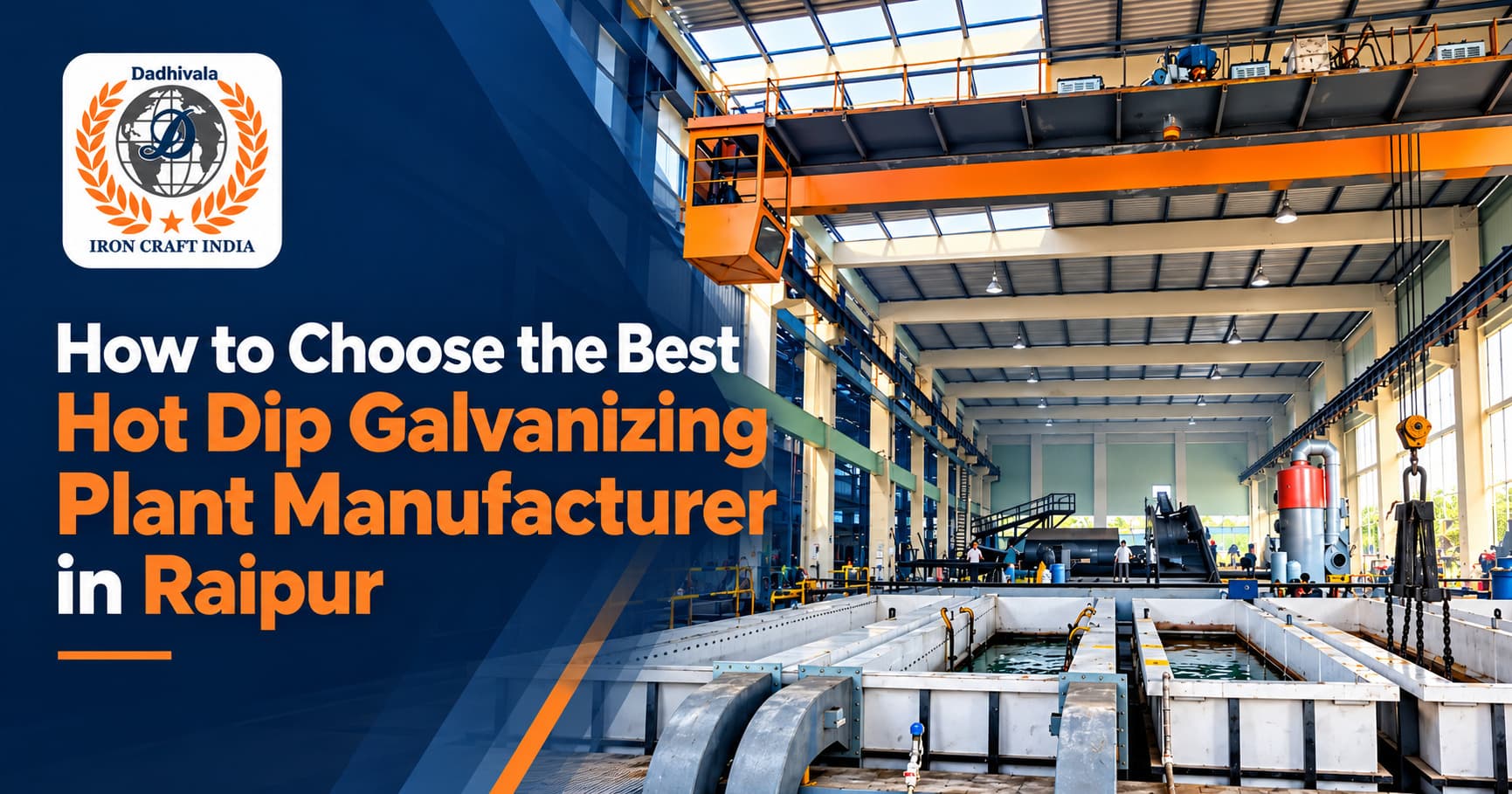
How to Choose the Best Hot Dip Galvanizing Plant Manufacturer in Raipur
The best hot dip galvanizing plant manufacturer in Raipur is one with proven plants in the Raipur steel belt and quality kettle and furnace engineering. It should also offer a complete turnkey scope covering design, supply, installation, commissioning and pollution control. Before you choose, check local references, plant setup expertise, itemised pricing and after-sales support.
Hot dip galvanizing protects steel from corrosion for decades, which makes it essential for pipes, structures, poles, crash barriers and solar mounting structures. For steel producers, adding galvanizing turns black steel into a higher-value product and opens new markets.
Raipur is one of central India's most important steel centres. According to Outlook Business, about 70% of units in the Urla industrial cluster make steel or steel-related products, and Siltara hosts larger industrial units. With so much pipe, strip and structural steel produced locally, a hot dip galvanizing plant in Raipur makes strong commercial sense.
At Dadhivala Galvanizing, we have designed and built galvanizing plants since 1987. In the Raipur region, our clients include Sambhv Sponge & Power, Shree Nakoda Pipe Impex (Hector), R.R Ispat (Hira Group), Shivam Overseas (Iskon Strips) in Guma, Sadhguru Pipes and Krishna Iron & Strips in Urla, and Kunal Pipes in Durg. This guide shares what we have learned from building plants in the region.
Understanding Hot Dip Galvanizing
Definition and Process
Hot dip galvanizing is the process of coating steel by immersing it in molten zinc. According to the American Galvanizers Association, the bath is kept at 438–460°C and contains at least 98% zinc, and most items are immersed for less than ten minutes. The zinc reacts with the steel to form a tough, metallurgically bonded coating.
The process follows a fixed sequence:
- Degreasing: Removes oil, grease and dirt.
- Pickling: Dilute acid removes rust and mill scale.
- Rinsing: Removes acid residue.
- Fluxing: Prevents oxidation before dipping.
- Drying: Pre-heats the steel and removes moisture.
- Galvanizing: Immersion in the zinc kettle.
- Quenching and passivation: Cools the steel and protects the fresh coating.
- Inspection: Checks coating thickness and finish.
Benefits of Hot Dip Galvanizing for Metal Protection
- Long service life: Decades of protection with little maintenance.
- Complete coverage: Inside and outside surfaces, edges and corners are all coated.
- Sacrificial protection: Zinc corrodes first and protects exposed steel at cuts and scratches.
- Lower lifetime cost: No repeated painting.
- Higher product value: Galvanized pipes and structures command better prices and open infrastructure, power and solar markets.
Key Features to Look for in a Hot Dip Galvanizing Plant Manufacturer
Not all galvanizing plant manufacturers in Raipur and across India offer the same depth of engineering. Focus on these features.
Experience and Expertise in Galvanizing
- Product experience: Has the manufacturer built plants for your product, whether pipes, structures, poles or solar structures?
- Regional references: Can you visit a plant they built in the Raipur–Bhilai–Durg belt?
- Design capability: Do they size the kettle, tanks and cranes from your target capacity, or offer a standard package?
- Problem solving: Ask how they handle bottlenecks, dross control and zinc consumption.
Quality of Materials and Technology Used
- Zinc kettle: Look for boiler-quality steel plate, controlled welding and leak testing. Dadhivala's zinc kettles use 40–60 mm plate and come in lengths up to 15 m.
- Furnace: Efficient burners, uniform heating and accurate temperature control protect the kettle and save fuel.
- Tanks: Acid-resistant pickling tanks and polypropylene tanks last longer and reduce leaks.
- Fume control: Zinc fume and acid fume scrubbers protect workers and support environmental compliance.
Certifications and Compliance with Industry Standards
Ask which standards guide the design, such as IS and ASTM requirements for materials and coatings, and whether certified welding procedures are used. In Chhattisgarh, galvanizing plants need consent from the Chhattisgarh Environment Conservation Board (CECB), the state pollution control authority. Because galvanizing involves acid pickling and zinc fumes, your plant needs proper fume extraction, acid handling and effluent treatment from the start.
Questions to Ask Before You Sign
- What output (TPD) will you guarantee for my product mix?
- What kettle plate thickness and steel grade will you use?
- Is the initial zinc charge included in the quote?
- What is included and excluded: civil work, cranes, effluent treatment?
- Who handles commissioning, training and spare parts?
Red Flags to Watch For
- No capacity guarantee or itemised scope
- No references in central India you can visit
- Fume scrubbers or effluent treatment treated as optional
- A price far below other quotes with no explanation
Plant Setup Considerations
Plant setup decides how smoothly your hot dip galvanizing plant in Raipur will run for the next 20 years or more. Get these decisions right before ordering equipment.
Space and Location Requirements
- Industrial zoning: Choose land in a notified industrial area such as Urla, Siltara or Sondra, where consents and utilities are easier to arrange.
- Proximity to steel supply: Locating near your pipe mill or structural fabrication unit cuts transport and handling costs.
- Shed size: The shed must house the full process line, crane runway, and loading and unloading bays.
- Crane height: Allow enough clear height to lift the longest items above the tanks.
- Utilities: Plan for power, water, fuel storage and an effluent treatment area.
- Expansion space: Reserve land for a longer kettle or a second line.
Illustrative layout example: A straight-line structure plant might have 12 stations: degreasing, four pickling tanks, two rinse tanks, a flux tank, a drying oven, the zinc kettle, a quench tank and a passivation tank. At about 1.5 m per station plus 0.5 m spacing, the process line is about 24 m long. Adding loading and unloading bays of about 10 m each gives a shed of roughly 44 m. A shed of about 50 m × 20 m (1,000 m²) would be a reasonable starting point. Actual sizes depend on your kettle length, product and capacity, so always base the final layout on an engineering study.
Essential Equipment and Machinery
| Equipment | Function | What to check |
|---|---|---|
| Degreasing tank | Removes oil and dirt | Heating and material |
| Pickling tanks | Remove rust and scale | Acid resistance, number of tanks |
| Rinse tanks | Remove acid residue | Overflow and water use |
| Flux tank | Prepares the surface | Filtration and heating |
| Drying oven | Pre-heats and dries steel | Temperature control |
| Zinc kettle and furnace | Galvanizes the steel | Plate thickness, burner efficiency |
| Quench and passivation tanks | Cool and protect the coating | Size matched to output |
| Fume scrubbers | Control zinc and acid fumes | Capture efficiency |
| Cranes and jigs | Move steel through the line | Capacity and speed |
| Effluent treatment | Treats spent solutions | Compliance with consent conditions |
Workflow and Operational Efficiency
- Straight or U-shaped layout: Material should move in one direction without backtracking.
- Balanced stations: Each tank must keep pace with the kettle, or the slowest station becomes the bottleneck.
- Enough pickling tanks: Pickling usually takes the longest, so several tanks work in rotation.
- Short crane moves: Shorter travel reduces cycle time and energy use.
- Safe zones: Separate the acid area from the kettle area, with clear walkways and splash protection.
For a deeper look at sizing, read our guide to galvanizing plant capacity and TPD calculation.
Cost Analysis
Breakdown of Hot Dip Galvanizing Plant Costs
A complete hot dip galvanizing plant cost in India usually includes:
- Process equipment: Kettle, furnace, tanks, drying oven and scrubbers
- Material handling: Cranes, hoists and jigs
- Electrical and controls: Panels, instrumentation and temperature controllers
- Civil work: Foundations, tank pits, shed and flooring
- Utilities: Fuel storage, water and effluent treatment
- Initial zinc charge: Often one of the largest single costs and frequently excluded from quotes
- Services: Installation, commissioning, training and approvals support
Hot Dip Galvanizing Plant Price in Raipur: Market Reference
There is no fixed hot dip galvanizing plant price in Raipur, because every plant is designed for a specific product and capacity. Listings on IndiaMART show the range across India:
| Plant type (as listed) | Listed price (₹) |
|---|---|
| Small semi-automatic structural plant | About 16.5 lakh |
| Semi-automatic MS galvanizing plant | About 40 lakh |
| Tube/pipe plant with 1,000 kg loading | About 65 lakh |
| Pole galvanizing plant | About 1 crore |
| Larger tube or HDG plants | About 2 crore |
| Automatic plant rated at 100 TPD | About 3 crore |
Listed marketplace prices, October 2026. Scope varies widely, so use these for orientation only.
Factors Influencing Pricing in Raipur
- Capacity (TPD): Higher output needs a larger kettle, more tanks and bigger cranes.
- Product type: Long poles need longer kettles; pipes need specialised handling.
- Automation level: Automatic lines cost more upfront but save labour and zinc.
- Fuel choice: LPG, PNG or furnace oil affects burner design and running cost.
- Civil and site conditions: Soil, existing sheds and crane runways change civil costs.
- Pollution control scope: Scrubbers and effluent treatment are essential and add cost.
- Freight and installation: Transport of the kettle and site work add to the total.
Comparison of Hot Dip Galvanizing Plant Suppliers in Raipur
| Supplier type | What you get | Best for | Watch-out |
|---|---|---|---|
| Turnkey manufacturer | Complete design, supply, installation, commissioning | New plants, first-time investors | Higher upfront price |
| Component supplier | Individual kettles, tanks or furnaces | Upgrades and replacements | You manage integration |
| Local fabricator | Basic tanks and structures | Small ancillary items | Limited process expertise |
When comparing hot dip galvanizing plant suppliers in Raipur, compare total cost of ownership, not just the quote. Zinc and fuel make up most running costs, so an efficient design often pays back its extra cost.
Ways to Manage Cost Without Cutting Quality
- Build in phases, starting with the kettle size you need today but leaving space to extend.
- Reuse existing sheds or crane runways where they suit the layout.
- Choose automation only where your volumes justify it.
- Invest in a drying oven and good burners, which lower fuel and zinc costs every day.
Automatic vs Manual Hot Dip Galvanizing Plants
Advantages of an Automatic Hot Dip Galvanizing Plant
- Consistent coatings: Controlled immersion and withdrawal give uniform thickness.
- Lower zinc use: Precise control reduces over-coating, the biggest hidden cost.
- Higher output: Faster, repeatable cycles increase tonnes per day.
- Less labour: Fewer operators per shift.
- Better safety: Less manual handling near molten zinc and acid.
Cost Considerations for Automatic Setups
| Factor | Manual / semi-automatic | Automatic |
|---|---|---|
| Upfront cost | Lower | Higher |
| Labour per shift | Higher | Lower |
| Coating consistency | Operator-dependent | High |
| Zinc consumption | Higher risk of over-coating | Better controlled |
| Best fit | Mixed products, lower volume | High-volume, uniform products such as pipes |
An automatic hot dip galvanizing plant suits high-volume pipe and tube producers in Raipur's Urla and Siltara clusters. Job galvanizers with mixed products often start with semi-automatic plants and automate later.
Turnkey Solutions for Hot Dip Galvanizing Plants
What Is a Turnkey Solution?
A turnkey solution means one manufacturer delivers a complete, working plant: design, engineering, fabrication, supply, installation, commissioning and training. You receive a plant that is ready to run.
How a Turnkey Project Runs
- Requirement study: Products, capacity, site and fuel are reviewed.
- Plant design: Layout, kettle size, tank sizes and crane specifications are finalised.
- Approvals support: Drawings and pollution control details are prepared for consent applications.
- Fabrication: The kettle, tanks, scrubbers and structures are built and tested in the factory.
- Civil coordination: Foundations, tank pits and the shed are prepared to the drawings.
- Installation: Equipment is delivered, erected and connected.
- Commissioning: The kettle is heated, zinc is charged and trial batches are run.
- Handover and training: Operators are trained, and spares and maintenance plans are handed over.
Benefits of Choosing a Turnkey Hot Dip Galvanizing Plant Manufacturer
- Single responsibility: One partner is accountable for capacity, quality and timelines.
- Matched equipment: Kettle, furnace, tanks, scrubbers and cranes are designed to work together.
- Faster start-up: Coordinated delivery and installation reduce delays.
- Lower risk: No gaps between suppliers or blame-shifting during commissioning.
- Easier approvals: Pollution control equipment is planned into the design.
- Training and support: Operators are trained, and spares are planned from day one.
Dadhivala is a turnkey hot dip galvanizing plant manufacturer offering pipe,tube,structure,pole and post and solar structure galvanizing plants.
Conclusion
Choosing the right hot dip galvanizing plant manufacturer in Raipur affects your plant's output, zinc consumption, compliance and profitability for decades. Look for regional experience, quality machinery, sound plant setup, transparent pricing and a full turnkey scope. Compare suppliers on total cost of ownership, and always visit a working plant before you sign.
With the Raipur steel belt producing large volumes of pipes, strips and structures, a well-designed galvanizing plant can add value to every tonne you make.
Planning a hot dip galvanizing plant in Raipur? Talk to a Dadhivala engineer for a free capacity study and turnkey quote, or browse our products and plant gallery.
Frequently Asked Questions
- Who is the best hot dip galvanizing plant manufacturer in Raipur?
The best choice has proven plants in the Raipur region, strong kettle and furnace engineering, a full turnkey scope and reliable after-sales support. Ask for local references and visit a working plant before deciding.
- What is the hot dip galvanizing plant price in Raipur?
Prices depend on capacity, product and automation. Indian marketplace listings range from about ₹16.5 lakh for small semi-automatic plants to ₹2–3 crore or more for large or automatic lines.
- How much land is needed for a galvanizing plant?
A mid-size structure plant may need a shed of roughly 1,000 m², plus space for utilities, storage and effluent treatment. The exact area depends on kettle length and capacity.
- Is an automatic hot dip galvanizing plant worth the investment?
For high, uniform volumes such as pipes, yes. Automation improves consistency, cuts labour and reduces zinc consumption.
- What does a turnkey hot dip galvanizing plant manufacturer provide?
Design, fabrication, supply, installation, commissioning and training, all under one contract.
- What approvals are needed for a galvanizing plant in Raipur?
You need consent from the Chhattisgarh Environment Conservation Board, along with fume control, acid handling and effluent treatment systems.
- How long does galvanizing take?
Immersion usually takes less than ten minutes. Pre-treatment, especially pickling, takes longer, so a full batch cycle often takes an hour or more.
- Which products can a galvanizing plant in Raipur process?
Pipes, tubes, angles and channels, transmission and lighting poles, crash barriers, fencing and solar mounting structures.
- Can an existing steel plant add galvanizing?
Yes. Many pipe and strip producers add a galvanizing line next to their existing mill to sell higher-value galvanized products.
- What is the biggest running cost?
Zinc is usually the largest operating cost, followed by fuel, chemicals and labour.
- How long does a zinc kettle last?
It depends on plate quality, temperature control and bath chemistry. A well-built, well-run kettle lasts many years.
- Does Dadhivala have experience in Raipur?
Yes. Our clients in the region include Sambhv Sponge & Power, Shree Nakoda Pipe Impex, R.R Ispat (Hira Group), Shivam Overseas, Sadhguru Pipes, Krishna Iron & Strips and Kunal Pipes. See our clientele page.