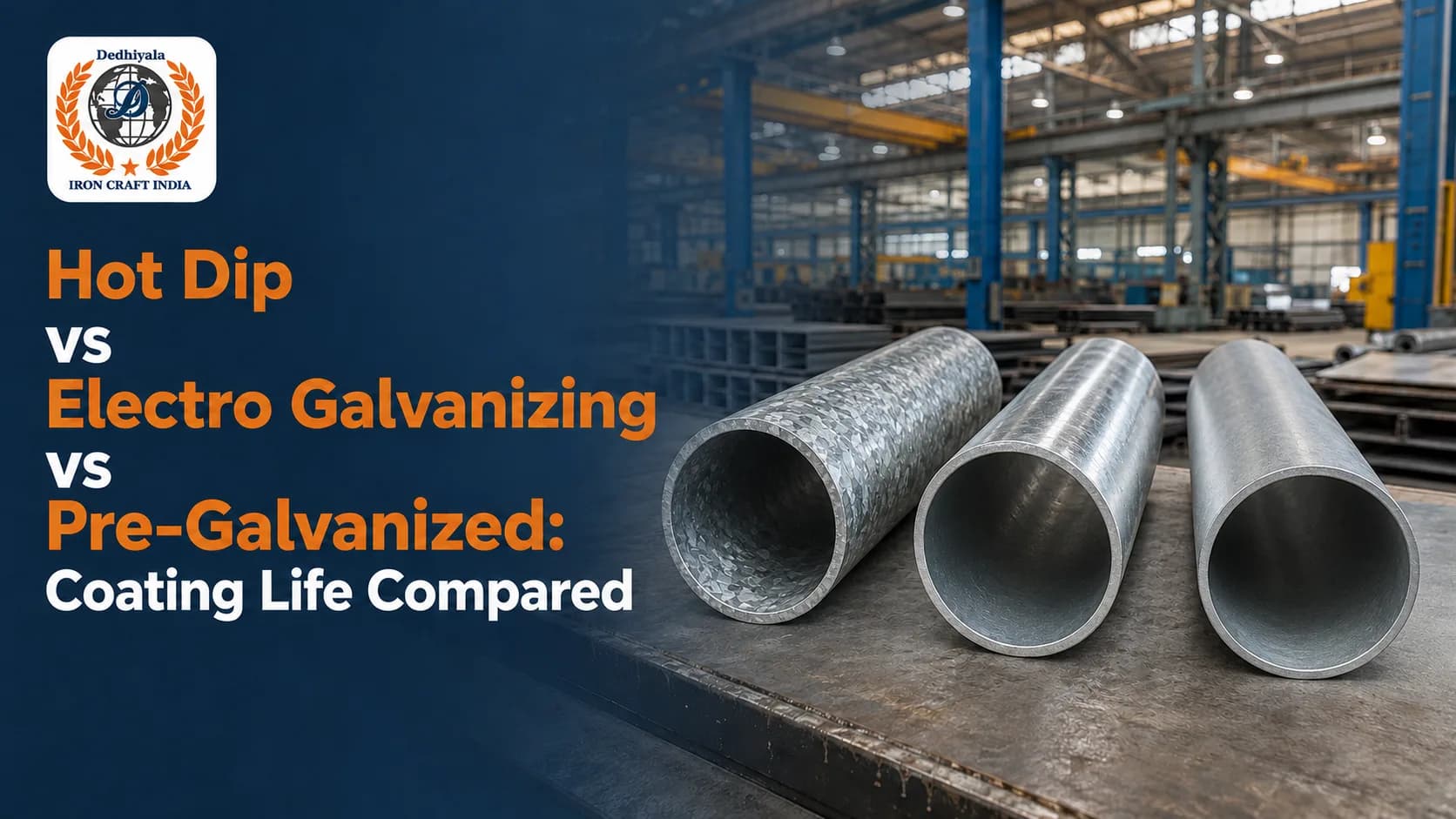
Hot-dip galvanizing (HDG) protects steel for roughly 20-70 years, pre-galvanized (mill-galvanized) sheet for about 10-25 years, and electro-galvanized (EG) steel for only 5-15 years before red rust appears. The difference comes down to zinc coating thickness: HDG builds a thick, metallurgically bonded 45-85+ micron coating, pre-galvanized around 15-30 microns, and electro-galvanized just 5-25 microns. In coastal or industrial (C4-C5) environments, HDG can outlast electro-galvanizing by 5-7 times.
For any buyer of steel that lives outdoors - crane structures, pre-engineered buildings (PEBs), water tanks, transmission poles, highway barriers - the real question is not “is it galvanized?” but “how long will the zinc actually last?” Not all galvanizing is equal. Hot-dip, electro, and pre-galvanized coatings differ enormously in thickness, durability and lifecycle cost. This guide compares all three on coating life by environment, shows where each one fails first, and helps you choose the right method for the job.
1. Hot Dip vs Electro Galvanizing vs Pre-Galvanized: What's the Real Difference?
All three coat steel with zinc, but the process - and when in production the zinc is applied - changes everything.
- Hot-Dip Galvanizing (HDG) - fabricated steel is dipped in a bath of molten zinc at about 450 °C. The zinc reacts with the steel to form tough, metallurgically bonded zinc-iron alloy layers. Crucially, it is applied AFTER fabrication, so welds, corners and cut edges are all coated. Governed by ASTM A123 / ISO 1461.
- Electro-Galvanizing (EG) - zinc is deposited onto steel from a chemical solution using an electric current (electroplating). It produces a thin, bright, smooth cosmetic layer, applied cold. Common on sheet, fasteners and automotive parts. Governed by ASTM A879 / EN 10152.
- Pre-Galvanized (Mill-Galvanized) - steel coil is continuously hot-dip coated at the mill, then slit, roll-formed or welded into products such as tubes and light sections. Because the zinc is applied BEFORE fabrication, any cut edge or weld made afterwards is left bare. Governed by ASTM A653 / EN 10346 (coating designations like Z275, Z450).
The key distinction: HDG is applied after fabrication and covers welds and cut edges; pre-galvanized and electro-galvanized coatings are applied before fabrication, leaving welds and cut edges exposed - and those bare spots are exactly where rust begins.
2. How Galvanized Coatings Protect Steel: Barrier + Sacrificial Action
Zinc defends steel in two ways at once, and this is why galvanizing outperforms paint on bare-steel edges:
- Barrier protection - the zinc layer physically seals the steel away from moisture and oxygen. The thicker the layer, the longer this barrier lasts.
- Sacrificial (galvanic) protection - zinc is more reactive than iron, so at a scratch, drilled hole or cut edge the zinc corrodes first and protects the exposed steel, like a sacrificial anode. This “self-healing” effect works only as long as there is enough zinc nearby.
Both mechanisms depend on how much zinc is present. A thick hot-dip coating provides years of barrier protection plus a large reservoir of sacrificial zinc; a thin electro-galvanized flash offers little of either once scratched.
3. Coating Thickness Matters: Microns, Grams/m², and Service Life
Coating life is almost directly proportional to the mass of zinc on the surface. That is why microns (μm) and grams per square metre (g/m²) are the single best predictors of how long a coating will last. As a reference, 1 μm of zinc ≈ 7.1 g/m² per side.
| Coating Designation | Typical Zinc Thickness | Where It Is Used |
|---|---|---|
| HDG (ASTM A123) | 45-85+ μm (thicker on heavy steel) | Fabricated structures, poles, barriers |
| Pre-galv Z275 | ~20 μm per side | Tubes, light sections, coil products |
| Pre-galv Z450 | ~32 μm per side | Heavier-duty coil products |
| Electro-galv (EG) | 5-25 μm (often 5-12) | Indoor parts, fasteners, auto panels |
Notice the pattern: hot-dip coatings are typically 2-4 times thicker than pre-galvanized and up to 10 times thicker than a commercial electro-galvanized flash - which is exactly why their lifespans diverge so sharply.
4. Hot-Dip Galvanizing (HDG): Process, Thickness, and Lifespan
In hot-dip galvanizing, cleaned and fluxed steel is immersed in molten zinc. The metallurgical reaction forms a series of hard zinc-iron alloy layers topped by pure zinc, bonded to the steel rather than merely sitting on it. Typical coatings run 45-85+ μm and can exceed 100 μm on thick sections.
- Lifespan: about 20-70 years depending on environment; 40-70 years in rural/dry conditions.
- Strengths: thickest coating, covers welds and edges, abrasion-resistant, effectively maintenance-free.
- Trade-offs: higher upfront cost, matte grey finish, part must fit in the kettle.
5. Electro-Galvanizing (EG): Smooth Finish, Thin Layer, Limited Life
Electro-galvanizing plates a thin, uniform, bright zinc layer using electric current in a zinc-salt bath. The finish is smooth and paint-ready, which is why it is popular for automotive panels, appliances and indoor fasteners. But the coating is thin - typically 5-25 μm - so outdoor life is limited.
- Lifespan: roughly 5-15 years, dropping to just 3-7 years in coastal/marine air.
- Strengths: excellent cosmetic finish, tight thickness control, good for cold-formed and precision parts.
- Trade-offs: too thin for aggressive outdoor exposure; needs paint or topcoat for long outdoor service.
6. Pre-Galvanized (Mill-Galvanized) Steel: Where It Fits in the Spectrum
Pre-galvanized steel is hot-dip coated as flat coil at the steel mill, then fabricated into products. The coating (commonly Z275 to Z450, i.e. ~20-32 μm per side) is thinner and more uniform than batch HDG. It offers a good balance of cost and protection for coil-formed products - but every cut, drilled hole and weld exposes bare steel that relies on sacrificial zinc alone.
- Lifespan: about 10-25 years in mild/urban conditions, less near the coast.
- Strengths: economical, smooth, ideal for high-volume tube and light-gauge products.
- Trade-offs: thinner than batch HDG; cut edges and welds are weak points unless touched up.
7. Coating Life Compared: HDG vs EG vs Pre-Galvanized by Environment
Zinc life depends heavily on the corrosivity of the surrounding air (ISO 9223 categories C1-C5). The table below compares typical service life to first red rust across three broad environments.
| Coating Type | Typical Thickness | Rural / Dry | Urban / Industrial | Coastal / Marine |
|---|---|---|---|---|
| Hot-Dip Galvanizing (HDG) | 45-85+ μm | 40-70 years | 25-40 years | 15-30 years |
| Pre-Galvanized (Mill) | 15-30 μm (Z275-Z450) | 20-35 years | 10-20 years | 5-15 years |
| Electro-Galvanizing (EG) | 5-25 μm | 10-20 years | 5-10 years | 3-7 years |
Rule of thumb: In aggressive C4-C5 (industrial and coastal) environments, hot-dip galvanizing lasts about 5-7× longer than an electro-galvanized coating of typical commercial thickness.
Rural / Inland Dry
Low humidity and low pollution mean slow zinc loss. Even here HDG dominates on longevity, but thinner coatings are more acceptable for non-critical items.
Urban / Industrial
Sulphur dioxide, moisture and grime accelerate corrosion. Pre-galv and EG life drops sharply; HDG remains the safe choice for structural steel.
Coastal / High Humidity / Marine
Airborne chlorides are the harshest test of any zinc coating. Thin EG coatings can fail in a few years, so specifiers move to thick HDG - and often duplex (HDG + paint) systems - for real durability.
8. Welds, Cut Edges, and Fasteners: The Weak Points of Each Coating
This is where the after-vs-before-fabrication difference becomes decisive:
- HDG - galvanized after fabrication, so welds, corners, internal surfaces and cut edges are all fully coated. This is a major reason it outlasts the others on real structures.
- Pre-galvanized & EG - galvanized before fabrication, so any weld or cut made afterwards exposes bare steel. Small gaps self-heal via sacrificial zinc, but large exposed welds corrode first and usually need zinc-rich touch-up.
For welded assemblies - crane girders, PEB frames, tank shells - exposed weld zones are often the first place red rust appears on pre-galvanized or electro-galvanized steel, which is why hot-dip galvanizing after fabrication is preferred for structural work.
9. Cost vs. Longevity: Which Galvanizing Method Saves More Over 20-30 Years?
Judging galvanizing on upfront price alone is misleading. The metric that matters for plant owners is total cost of ownership (TCO) - initial cost plus maintenance, downtime and replacement over the asset's life.
- Upfront cost - EG and pre-galv are cheaper to buy; batch HDG costs more per tonne.
- Maintenance - HDG is effectively maintenance-free for decades; thin coatings and paint need periodic recoating (often every 5-10 years), each cycle adding labour, access and downtime cost.
- Lifecycle - across a 20-30 year horizon, HDG frequently has the lowest total cost because it avoids repeated repainting and premature replacement, despite the higher initial price.
For long-life outdoor assets, spending more on a thicker hot-dip coating once is usually cheaper than maintaining a thin coating repeatedly.
10. How to Choose the Right Galvanizing Type for Cranes, PEBs, and Water Tanks
| Application | Recommended Coating | Why |
|---|---|---|
| Crane & heavy structures | Hot-dip galvanizing | Thick coating covers welds; withstands abrasion and load. |
| PEB / outdoor steel frames | Hot-dip galvanizing | Long maintenance-free life in urban/industrial air. |
| Water tanks & wet service | HDG (or duplex) | Constant moisture demands maximum zinc thickness. |
| Highway barriers & poles | Hot-dip galvanizing | Outdoor, safety-critical, decades of service required. |
| Coastal / marine projects | HDG + paint (duplex) | Chlorides need the thickest possible protection. |
| Indoor light-duty / cosmetic | Pre-galv or EG | Low corrosion risk; finish and cost matter more. |
As a simple guide: for anything structural, outdoor or near the coast, specify hot-dip galvanizing. Reserve pre-galvanized and electro-galvanized steel for indoor, light-duty or cosmetic uses where a thinner coating is acceptable.
FAQs: Common Questions on Galvanized Steel Coating Life
1. What is white rust on galvanized steel, and does it reduce coating life?
White rust is a bulky white deposit that forms when freshly galvanized steel is stored wet with no air circulation - typically when parts are bundled or stacked without spacers. Light white rust is mostly cosmetic and rarely shortens service life once the surface dries and forms its normal grey patina. Heavy white rust that removes measurable zinc can reduce life, so store galvanized steel dry, with spacers and good ventilation.
2. How can you tell hot-dip from electro-galvanized or pre-galvanized steel by looking?
Hot-dip galvanizing has a thicker matte-grey finish, often with a visible crystalline “spangle” and slightly rougher texture, and it coats welds, corners and edges - sometimes with small zinc runs at drainage points. Electro-galvanized steel is very smooth, bright and thin. Pre-galvanized products look smooth and uniform but show bare, silvery cut edges and uncoated weld seams. Coated welds and edges are the clearest sign of true hot-dip galvanizing.
3. Can you paint or powder-coat over galvanized steel (a duplex system)?
Yes. Applying paint or powder coat over hot-dip galvanizing creates a “duplex” system, and the two protect each other synergistically - combined life is greater than the sum of each alone, often 1.5 to 2.3 times longer. The surface must be properly prepared (weathered or sweep-blasted and primed) for good adhesion. Duplex systems are popular for coastal projects and colour-coded structures.
4. How is galvanized coating thickness checked on site?
Coating thickness is measured with a magnetic or electronic thickness gauge at several points on the part, then averaged and compared against the minimum required by ASTM A123 / ISO 1461 for that steel section. Because service life tracks zinc thickness closely, verifying the microns on delivery is the simplest quality check a buyer can perform.