
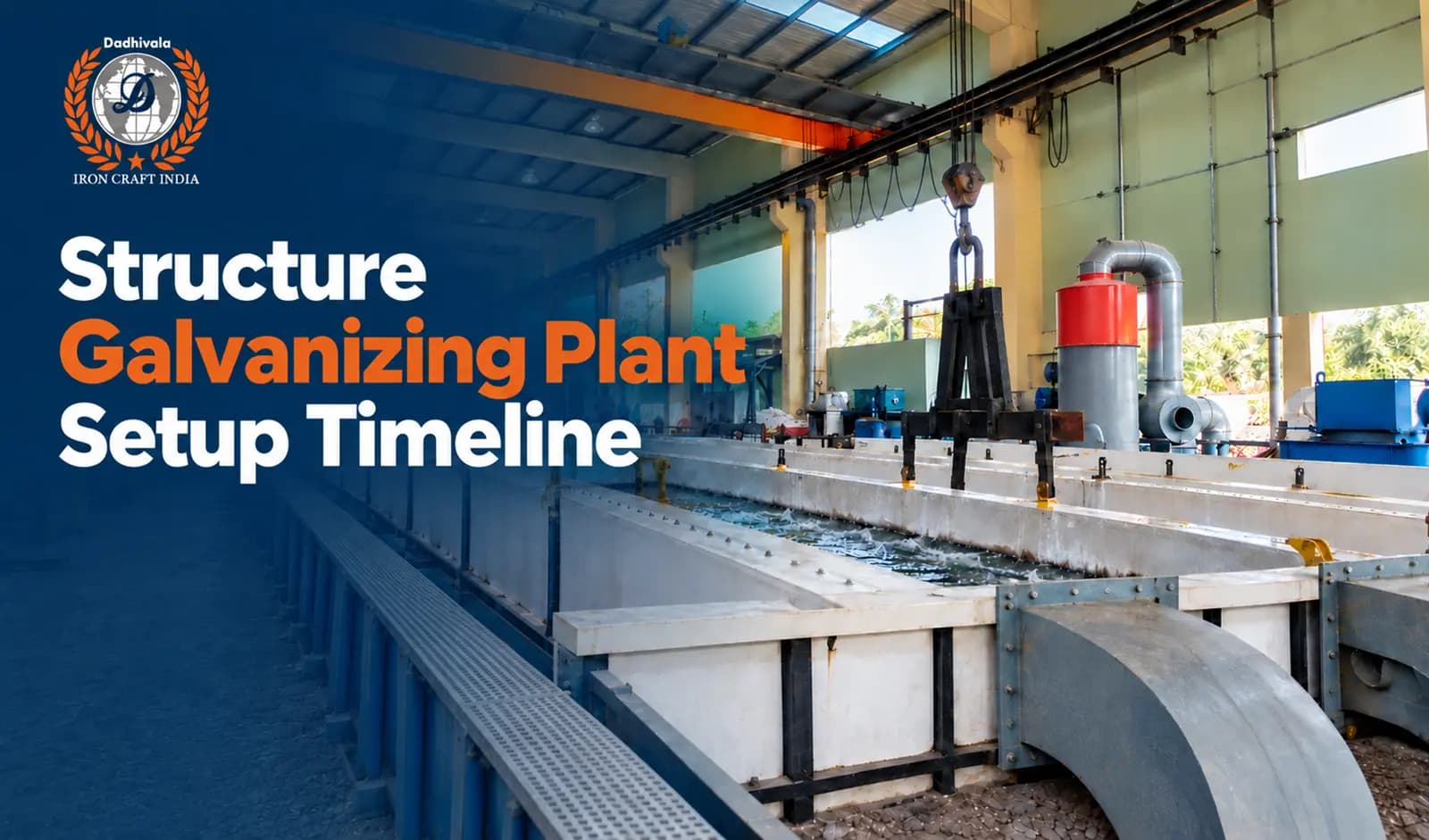
A turnkey structure galvanizing plant typically takes about 9-12 months to set up - from feasibility study and site planning to civil work, equipment installation, commissioning and trial production. The exact timeline depends on plant capacity, kettle size, equipment lead times, approvals and site readiness. Because several stages run in parallel, good project coordination is what keeps the schedule to the shorter end of that range.
How Long Does It Take to Set Up a Structure Galvanizing Plant?
If you fabricate structural steel and want galvanizing under your own roof, the first question is always time: how many months from decision to dispatch? The honest answer is that the structure galvanizing plant setup timeline is a range, not a fixed number. A well-coordinated turnkey project usually runs 9-12 months, but capacity, kettle size, equipment availability, civil work and regulatory approvals can move that in either direction.
The key thing to understand is that these stages don't all happen one after another. Approvals, civil construction and equipment manufacturing overlap heavily - and how well those parallel tracks are managed decides whether you commission in nine months or fifteen. Below is a realistic, stage-by-stage view of the whole journey.
Structure Galvanizing Plant Setup Timeline at a Glance
| Project stage | Main activities | Indicative duration |
|---|---|---|
| Feasibility & market study | Product analysis, demand assessment, capacity & financial planning | 2-4 weeks |
| Site selection & approvals | Land evaluation, utilities, environmental and factory approvals | 1-3 months |
| Plant design & engineering | Layout, material flow, kettle sizing, utility and safety design | 1-2 months |
| Civil construction | Foundations, production shed, tanks, drainage, yard & storage | 2-4 months |
| Equipment manufacturing | Kettle, furnace, tanks, cranes, pollution-control systems | 3-6 months |
| Equipment installation | Mechanical, electrical, piping and automation work | 1-2 months |
| Testing & commissioning | Dry runs, heating, process checks, safety tests, operator training | 2-4 weeks |
| Trial & commercial production | Test batches, quality checks, adjustments, production launch | 2-6 weeks |
Treat these as indicative ranges, not fixed promises - they overlap, as the next section explains.
Critical Path vs Parallel Activities: Why the Stages Overlap
Add up every stage duration in isolation and you'd fear an 18-month project. In practice it's far shorter, because the big blocks run side by side. Understanding the critical path - the chain of tasks that actually controls the finish date - is what separates a 9-month setup from a 15-month one.
- The critical path - equipment manufacturing (the kettle and furnace especially) is usually the longest single activity, so it sets the pace. Order it early and build everything else around it.
- Runs in parallel - civil construction and equipment manufacturing happen at the same time; there's no reason to finish the shed before the kettle is being built.
- Overlaps early - environmental and factory approvals should be filed during detailed engineering, not after, so paperwork isn't holding up a finished plant.
- Overlaps late - operator hiring and SOP preparation can be done during installation, so the team is ready the day commissioning starts.
Stage 1: Conduct a Feasibility Study and Market Assessment
- Identify target products and customer industries.
- Estimate local demand and the competition.
- Analyse the structural steel sizes, weights and coating requirements you'll handle.
- Calculate expected plant capacity and revenue potential.
- Evaluate capital investment, operating cost and payback period.
Stage 2: Define Plant Capacity and Production Requirements
- Set daily and monthly production targets.
- Select the galvanizing kettle size to match your largest components.
- Assess maximum component dimensions and weights.
- Estimate zinc consumption.
- Plan shift operations and room for future expansion.
Stage 3: Select the Right Location
- Proximity to steel fabricators and infrastructure projects.
- Road, rail and port connectivity.
- Availability of industrial power, gas, water and drainage.
- Enough land for production, storage and vehicle movement.
- Availability of skilled labour.
- Adequate distance from residential and environmentally sensitive zones.
Stage 4: Complete Engineering Design and Plant Layout
- Raw-material receiving and inspection area.
- Degreasing, pickling, rinsing and fluxing sections.
- Galvanizing kettle and furnace area.
- Cooling, finishing, inspection and packing zones.
- Zinc ash and dross handling area.
- Crane paths, product-movement routes and worker-safety zones.
- An efficient layout cuts unnecessary movement and prevents bottlenecks between prep, dipping, cooling, inspection and dispatch.
Stage 5: Obtain Regulatory and Environmental Approvals
- Factory and manufacturing approvals.
- Environmental Consent to Establish and Consent to Operate, and emissions approvals.
- Fire and electrical safety approvals.
- Hazardous chemical (acid) storage permissions.
- Wastewater and hazardous-waste management compliance.
- Worker health and safety documentation.
Stage 6: Complete Civil Construction and Utility Preparation
- Production shed and equipment foundations.
- Galvanizing kettle foundation and pickling/rinsing tank foundations.
- Industrial flooring and acid-resistant drainage.
- Electrical substation and power distribution.
- Fuel/gas, water, ventilation and compressed-air systems.
- Storage yard and loading area.
Stage 7: Procure and Install Galvanizing Equipment
- Galvanizing kettle and zinc-heating furnace.
- Degreasing, pickling, rinsing and fluxing tanks.
- Overhead cranes and lifting systems.
- Cooling and quenching equipment.
- Fume-extraction and pollution-control systems.
- Finishing, inspection and packing equipment.
Stage 8: Install Electrical, Mechanical and Automation Systems
- Power cabling and control panels.
- Furnace and kettle temperature controls.
- Pumps, pipelines, valves and chemical-circulation systems.
- Crane controls and safety interlocks.
- Instrumentation, production monitoring and emergency shutdown systems.
Stage 9: Hire and Train the Plant Team
- Plant/production manager and process (metallurgical) engineer.
- Galvanizing operators, crane operators and material handlers.
- Quality inspectors and maintenance technicians.
- Safety and environmental personnel.
- Start hiring during installation so the team is ready for commissioning.
Stage 10: Conduct Pre-Commissioning Checks
- Inspect civil foundations and equipment alignment.
- Test cranes and lifting equipment.
- Check tanks, pipelines, pumps and valves.
- Verify electrical systems and control panels.
- Test ventilation and fume extraction.
- Confirm safety equipment and emergency procedures.
Stage 11: Run Equipment Testing and Commissioning
- Dry testing without production material.
- Heating and furnace performance testing; kettle temperature stabilisation.
- Chemical-tank process checks.
- Crane and material-flow testing.
- Pollution-control system testing.
- Hands-on operator training during commissioning.
Stage 12: Begin Trial Production
- Select suitable test components and inspect steel before prep.
- Run degreasing, pickling, rinsing and fluxing cycles.
- Dip structural components into molten zinc.
- Check coating thickness, appearance, adhesion and uniformity against ASTM A123 / ISO 1461.
- Correct process parameters before full-scale production.
Stage 13: Move from Trial Runs to Commercial Production
- Approve the first production batches and standardise operating procedures.
- Finalise inspection and documentation systems.
- Confirm production capacity and cycle time.
- Begin regular customer dispatches.
- Track zinc consumption, rejection rate, downtime and energy use.
What Can Delay a Galvanizing Plant Setup?
- Delayed environmental and factory approvals.
- Wrong estimation of kettle size or product dimensions.
- Long equipment-manufacturing lead times.
- Civil construction or foundation errors.
- Delayed electrical or gas connections.
- Poor material-flow planning.
- Shortage of skilled operators.
- Incomplete pollution-control systems.
- Unsuccessful trial batches.
- Layout changes made during construction.
How to Reduce the Galvanizing Plant Installation Timeline
- Freeze product dimensions and capacity before selecting equipment.
- Use an experienced turnkey galvanizing plant supplier who sequences the parallel tracks.
- Begin approval work during detailed engineering.
- Order long-lead equipment (kettle, furnace) early.
- Run civil construction and equipment manufacturing in parallel.
- Freeze the plant layout before construction starts.
- Prepare SOPs and recruit operators before commissioning.
- Schedule factory-acceptance and site-acceptance tests.
- Keep a detailed project milestone tracker.
Structure Galvanizing Plant Setup Timeline: Month-by-Month Plan
| Period | Focus |
|---|---|
| Month 1 | Feasibility, market research and capacity planning |
| Months 2–3 | Site selection, approvals, engineering and layout |
| Months 3–6 | Civil construction and equipment manufacturing (in parallel) |
| Months 6–8 | Equipment delivery and installation |
| Months 8–9 | Electrical, piping, automation and safety-system integration |
| Months 9–10 | Testing, commissioning and operator training |
| Months 10–12 | Trial production, optimisation and commercial launch |
Frequently Asked Questions
1. Can I convert an existing factory shed into a galvanizing plant instead of building new?
Often, yes - and it can shorten the timeline. A structurally sound shed with adequate height, floor load and utilities can be adapted for the line, saving much of the civil-construction stage. It still needs the right kettle foundation, acid-resistant flooring and drainage, and ventilation, so a suitability survey is done before committing.
2. How much land is typically needed for a structure galvanizing plant?
It depends on capacity and the size of the structures you handle, but a small-to-mid structural galvanizing plant generally needs enough covered area for the process line plus open yard for steel storage and vehicle movement. Because structures are long and bulky, storage and handling space often matters more than the process line itself - the layout stage sizes this precisely.
3. How long does the galvanizing kettle last after the plant is set up?
A kettle built from the correct low-silicon boiler-grade steel and run at controlled temperatures commonly lasts 8-12 years. Planning for an eventual kettle change from day one - access, handling and a zinc-drain plan - avoids a long, unplanned shutdown later.
4. Is a turnkey plant faster to set up than sourcing equipment separately?
Usually, yes. With a turnkey supplier, design, fabrication, installation and commissioning are coordinated by one team, and the parallel tracks (civil work, equipment, approvals) are sequenced deliberately. Sourcing the kettle, tanks, cranes and controls from different vendors adds coordination gaps that tend to stretch the schedule.