
Pickling in Galvanizing: HCl vs H₂SO₄, Which Acid Is Better?
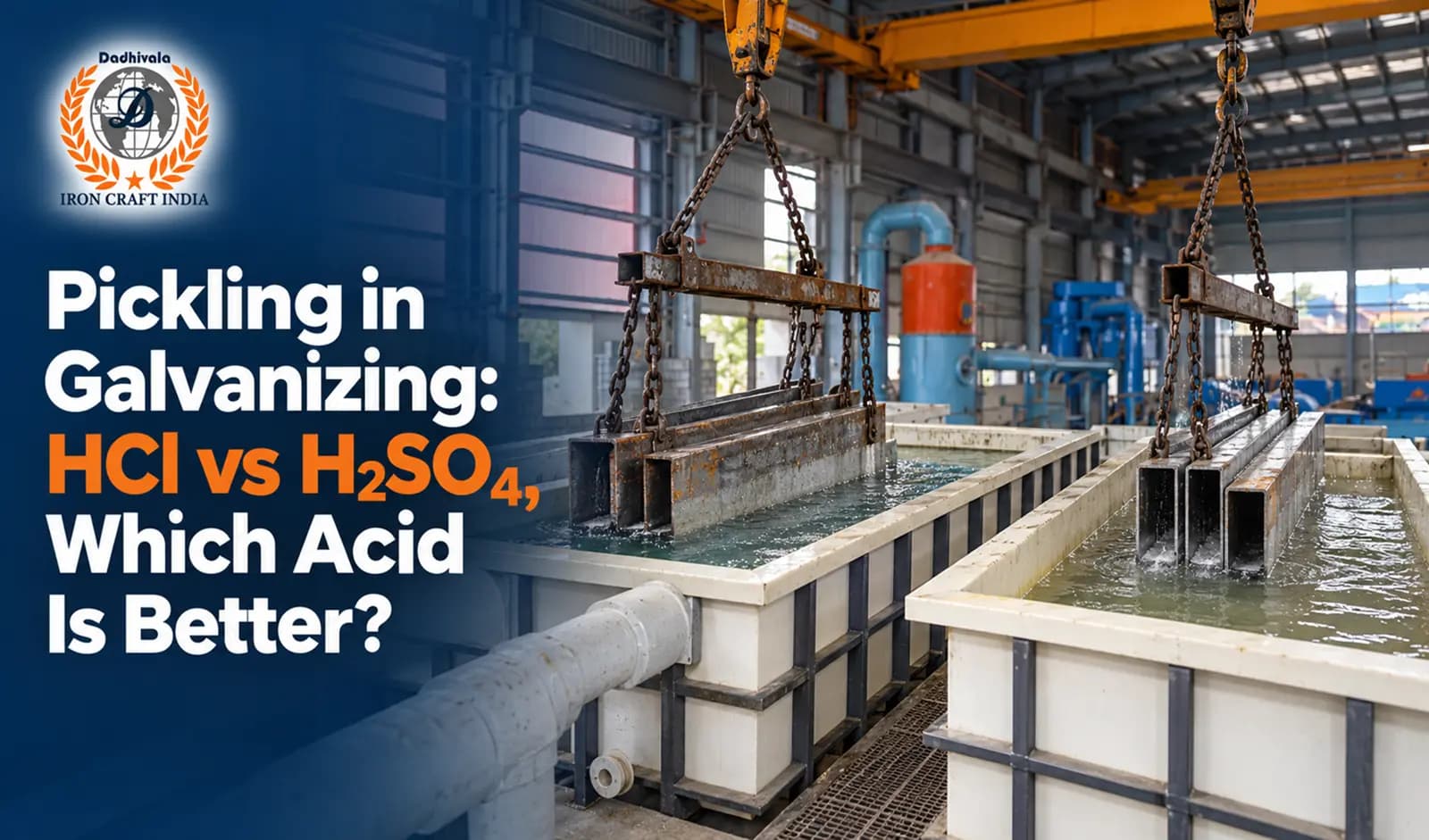
Pickling in galvanizing is the step where steel is dipped in acid to remove rust, mill scale and iron oxides before it goes into the zinc bath. Molten zinc reacts only with clean steel, so poor pickling leads to bare spots and weak coatings.
Two acids are used: hydrochloric acid (HCl) and sulphuric acid (H₂SO₄). For most batch hot-dip galvanizing plants, HCl is the better all-round choice. It works at room temperature, leaves a smoother surface and carries less iron into the zinc bath. H₂SO₄ still makes sense in some cases, covered below.
What Is Pickling in Galvanizing?
Pickling is a chemical cleaning step. Steel is dipped in a dilute acid bath that dissolves rust and mill scale and exposes bare metal. In hot-dip galvanizing, that bare iron reacts with molten zinc to form the zinc-iron layers of the coating. Without pickling, the zinc has nothing clean to bond with.
Why zinc will not bond to rusty or scaled steel
Hot-dip galvanizing is a metallurgical reaction, not a paint layer. Zinc must touch pure iron to form the alloy layers. Any oxide, scale or rust between the two blocks this reaction. The American Galvanizers Association (AGA) says the steel must be completely free of oil, grease, metal oxides, mill scale and rust before galvanizing.
The zinc bath will not "burn off" leftover scale. Uncleaned patches come out bare or with a thin, patchy coating.
Where pickling sits in the galvanizing line
A typical batch line runs in this order:
- Degreasing. Removes oil, grease and cutting fluids.
- Rinsing. Stops degreaser from going into the acid.
- Pickling. Removes rust and mill scale.
- Rinsing. Removes acid and loose iron salts.
- Fluxing. Protects the clean surface and helps the zinc wet the steel.
- Galvanizing. The steel is dipped in molten zinc.
- Quenching and passivation. Cools the work in quenching and passivation tanks and protects the fresh coating.
Practical tip: Acid cannot remove oil. If parts come out of the pickling tank with dark, uncleaned patches, check the degreasing tank first.
How Does Acid Pickling Work?
The acid seeps through cracks in the mill scale and dissolves the oxide layer next to the steel. Large flakes of scale then lift off instead of slowly dissolving. Once the surface is clean, the acid starts attacking the steel itself, which is why immersion time has to be controlled.
What the acid removes, and what it does not
- Rust: hydrated iron oxide from storage and weather.
- Mill scale: the hard, bluish-black oxide formed during hot rolling.
- Light oxides from welding and heat treatment.
Acid does not remove paint, welding slag, heavy grease or marker ink. These need mechanical cleaning or the right degreaser before pickling. Fabricators often number parts with paint markers; ask them to use water-soluble markers or tags instead, because paint survives pickling and leaves an ungalvanized patch.
Why rinsing after pickling matters
After pickling, loose iron salts stay on the steel. If they reach the zinc bath, they form dross, a zinc-iron waste that sinks to the floor of the galvanizing kettle. A review by the National Metallurgical Laboratory (NML), Jamshedpur gives these figures:
- In dross, one part of iron combines with about 24 parts of zinc.
- About 90–95% of the iron in dross comes from the steel being galvanized.
- Roughly half of that iron (50–55%) comes from loose salts left on the surface after pickling.
The same review found that hot rinsing removes these salts better than room-temperature rinsing.
Practical tip: A poor rinse costs you zinc. Keep the rinse water clean and change it on a set schedule, not only when it looks dirty.
HCl vs H2SO4 for Pickling: Side-by-Side Comparison
Both acids clean steel well. They differ in temperature, surface finish, safety and running cost. The table below is based on the AGA and NML sources cited in this article.
| Factor | Hydrochloric acid (HCl) | Sulphuric acid (H₂SO₄) |
|---|---|---|
| Operating temperature | Room temperature | Heated bath |
| Pickling speed at 25°C | Much faster | Slow unless heated |
| Surface finish | Smoother, brighter | More uneven; blistering risk |
| Hydrogen absorption | Lower | Higher |
| Iron carry-over to zinc bath | Lower | Higher |
| Volatility and fumes | Volatile; worse when warm | Less volatile |
| Corrosion of plant and building | Higher | Lower |
| Transport strength | About 35% | About 98% |
| Spent-acid handling | Recovery systems expensive; higher disposal cost | Lower disposal cost |
Pickling speed and operating temperature
HCl does its job at room temperature. The AGA notes that at 25°C, HCl cleans much faster than sulphuric acid. H₂SO₄ needs a heated bath to work at a practical speed, which means steam coils or heaters and the fuel to run them. Raising the temperature also lets sulphuric acid pickle effectively at a lower concentration.
HCl is kept at room temperature on purpose. NML notes that its volatility rises with temperature, acid strength and iron content. Heating an HCl bath "to speed things up" loses acid as fumes and corrodes the shed, cranes and electrical panels.
Surface finish and zinc pick-up
HCl gives a smoother, brighter pickled surface. Sulphuric acid can leave an uneven or blistered surface, and NML calls this one reason sulphuric pickling makes galvanizing less economical. The AGA notes that a roughened, over-pickled surface can produce an overly thick coating, which means more zinc used per tonne.
Hydrogen absorption and blistering
When acid reacts with steel, hydrogen is released. Most of it escapes as gas, but some enters the steel. The AGA lists greater hydrogen diffusion into the steel as a drawback of sulphuric acid, and NML links HCl with less hydrogen blistering.
Fumes, equipment corrosion and storage
This is where HCl loses points. It is volatile, and its fumes corrode steel structures, cranes and wiring nearby. An HCl plant needs:
- An acid fume extraction and scrubber system over the pickling tanks
- Acid-resistant tanks, usually PP, FRP or rubber-lined MS
- Proper acid storage tanks, placed away from the zinc kettle and electrical rooms
H₂SO₄ is less volatile, but it arrives at about 98% strength and gives off a lot of heat when diluted. Always add acid to water, never water to acid.
Practical tip: If you are planning a new line, include fume extraction in the first layout. Adding it later usually means cutting the roof and reworking ducts.
Total operating cost, not just acid price
The price of the acid alone does not tell you which one is cheaper. Compare the full running cost:
- Heating: H₂SO₄ baths need continuous heating; HCl baths do not.
- Zinc use: lower iron carry-over with HCl means less dross and less zinc lost.
- Transport: HCl arrives at about 35% strength, so you pay to move more water per kg of acid.
- Equipment life: HCl fumes shorten the life of structures and panels unless well controlled.
- Spent acid: the AGA notes HCl recovery systems are expensive and disposal costs are higher.
Acid prices in India change with supplier, location and order size. Get current quotes from two or three local suppliers before comparing. For the bigger cost picture, see the galvanizing plant setup cost breakdown.
Which Acid Should a Galvanizing Plant Choose?
For most batch hot-dip galvanizing plants, hydrochloric acid is the better choice. It cleans faster at room temperature, gives a smoother surface, lets less hydrogen into the steel and sends less iron into the zinc bath. Sulphuric acid suits plants already built around heated baths, or sites where chloride fumes are hard to manage.
The NML review supports this. It says many investigators have found HCl pickling superior, and that volatility, pollution and storage problems are why some plants still use sulphuric acid.
When HCl is the better choice
- You run batch galvanizing of structures, poles, crash barriers, pipes or general fabrication.
- You want lower zinc use and less dross.
- You do not want to spend on bath heating.
- You can install and maintain a proper acid fume scrubber.
When H2SO4 still makes sense
- Your plant already runs heated sulphuric acid tanks, and switching would mean new tanks and scrubbers.
- Your site finds chloride fumes hard to control, for example close to sensitive neighbours.
- You already have an approved route for handling sulphuric spent acid.
NML reports that adding common salt (sodium chloride) to a sulphuric acid bath gives several of HCl's benefits: faster pickling at a lower temperature, a brighter surface and less iron carry-over. Trial it at small scale before changing the full bath.
Example: a fabricator galvanizing mild-steel structures with moderate rust will usually do better with HCl, since it cleans quickly without heating and gives a better finish. A plant that already runs heated H₂SO₄ tanks with an approved spent-acid route may reasonably stay with sulphuric acid.
How to Control a Pickling Bath
The best acid still fails if the bath is not controlled. Most pickling problems come from weak acid, too much dissolved iron or the wrong immersion time.
Acid strength and iron content limits
The figures below are indicative ranges from published sources, not a fixed standard. Your steel, scale thickness and inhibitor supplier will affect the right numbers.
| Parameter | Indicative range | Source |
|---|---|---|
| HCl strength | 10–15% | Indian supplier process guide |
| HCl strength | 15–20% | NML Jamshedpur |
| H₂SO₄ strength | About 20% | NML Jamshedpur |
| Iron salts in the bath | Not above 8–10% | NML Jamshedpur |
| Pickling time | 10–30 minutes | Indian supplier process guide |
As iron builds up, pickling slows down even when you add fresh acid. When adding acid no longer restores the speed, the bath needs replacing.
Practical tip: Test acid strength and iron content at least once a shift and keep a log. A simple chart of these numbers warns you before the bath stops working.
Inhibitors and immersion time
Pickling inhibitors are chemicals that slow the acid's attack on bare steel without slowing scale removal. The right inhibitor reduces acid consumption, steel lost to the acid, and hydrogen pick-up and blistering.
The reaction chemistry shows why this matters. Every 1 kg of steel the acid dissolves uses up about 1.75 kg of pure sulphuric acid, or about 1.3 kg of pure HCl (roughly 3.7 kg of 35% commercial HCl). Steel the inhibitor protects is acid you do not have to buy.
Do not leave parts in the tank "to be safe." Take them out once the scale is gone. Extra time only eats steel and acid.
Common Pickling Defects and How to Prevent Them
| Defect | Main cause | Result | Prevention |
|---|---|---|---|
| Under-pickling | Weak acid or too much iron in the bath | Black spots, bare patches | Keep acid strength up and iron below about 8–10% |
| Over-pickling | Too much time, poor inhibitor | Rough surface, heavy coating, more zinc used | Good inhibitor, timed dips |
| Hydrogen blistering | Hydrogen trapped in steel | Blisters, brittleness | Suitable inhibitor, controlled time |
| Smutty surface | Unreacted carbide left on the surface | Dross in the zinc bath | Bath chemistry adjustment, good rinsing |
Under-pickling and black spots
Under-pickled steel still has scale on it. According to NML, black spots on galvanized work usually trace back to this, caused by weak acid or a bath overloaded with iron salts.
Over-pickling and excess zinc use
Over-pickled steel looks clean but has been etched too deeply. The AGA notes it can cause a rough surface, discolouration, loss of part size and weight, and an extra-thick coating. You pay for that extra coating in zinc.
Hydrogen embrittlement in high-strength steel
Hydrogen embrittlement is cracking caused by hydrogen trapped inside steel. For normal structural steel the risk is low. Per AGA guidance and ASTM A143, it is mainly a concern for steel with ultimate tensile strength above about 1,100 MPa (150 ksi) and for severely cold-worked parts. For such steel, the AGA suggests:
- Blast cleaning instead of full pickling, followed by a flash pickle of under 30 seconds
- Heating the steel to about 150°C (300°F) after cleaning to drive out hydrogen
Practical tip: Ask customers about steel grade and strength before galvanizing high-strength bolts, springs or hardened parts. In India, the code of practice for batch hot-dip galvanizing is IS 2629 (Part 1):2025, which replaced IS 2629:1985, IS 4759:1996 and IS 6159:1998.
Smutty surfaces
Sometimes steel looks pickled but has a dark, sooty film. NML explains this is cementite (iron carbide) from the steel that the acid did not dissolve. It is carried into the zinc bath and adds to dross. Correct bath chemistry and thorough rinsing reduce it.
Safety, Fume Control and Spent Acid Rules in India
Pickling creates three problems that many articles skip: risk to workers, acid fumes inside the plant, and spent acid leaving it.
Worker safety. Acid splashes cause burns, and HCl fumes irritate the eyes and lungs. Provide acid-resistant PPE, an eyewash and a safety shower near the tanks, and train staff on dilution and spill response. Factory safety duties now sit under the Occupational Safety, Health and Working Conditions Code, 2020; check the rules notified by your state.
Fume control. Most plants enclose the pickling area and fit an acid fume extraction and scrubber system. Keep tank covers on when the tanks are not in use.
Tank material. Acid tanks are usually made of polypropylene (PP), FRP or rubber-lined mild steel. Match the material to the acid, its strength and the bath temperature; this matters most for heated sulphuric acid baths. See the options for pickling unit tanks.
Spent acid. Used pickling acid is not ordinary wastewater. CPCB's SoP No. 71 lists spent HCl from steel pickling lines under Category 13.1 of Schedule I of the Hazardous and Other Wastes (Management and Transboundary Movement) Rules, 2016. In practice:
- You need authorisation from your State Pollution Control Board (SPCB), in addition to the plant's Consent to Establish and Consent to Operate.
- Spent acid must go to an authorised recycler or treatment facility, or be reused under approved conditions.
- Records of quantity and disposal must be kept.
Mistake to avoid: Never neutralise spent acid and drain it without SPCB approval. Conditions differ by state, so confirm your plant's consent conditions with your SPCB.
Key Takeaways
- Pickling in galvanizing removes rust and mill scale with acid so molten zinc can bond with bare steel.
- HCl is the preferred acid for most batch plants: room-temperature operation, smoother finish and less iron in the zinc bath.
- H₂SO₄ needs heating but is less volatile and is shipped at higher strength. It suits plants already set up for heated pickling.
- Bath control matters as much as acid choice: watch acid strength, iron content (at or below about 8–10%), immersion time and inhibitor dosing.
- Rinsing after pickling cuts zinc loss by keeping iron salts out of the kettle.
- Hydrogen embrittlement is mainly a concern for steel above about 1,100 MPa tensile strength.
- Spent pickling acid is hazardous waste in India and needs SPCB-authorised handling.
Final Thoughts on Pickling in Galvanizing
Good pickling in galvanizing decides how well the zinc bonds, how much zinc you use and how much dross you skim off. For most batch plants, hydrochloric acid gives the best balance of speed, finish and zinc economy, as long as fumes are well controlled. Sulphuric acid remains a fair option for plants built around heated baths.
Whichever acid you choose, the results come from daily discipline: testing the bath, timing the dips, rinsing well and handling spent acid by the rules. For the wider picture of layout, approvals and equipment, see the guide on how to set up a hot-dip galvanizing plant in India.
FAQs
Can you galvanize steel without acid pickling?
Not in standard hot-dip galvanizing, because zinc only bonds to fully clean steel. For high-strength or special parts, abrasive blasting can replace most of the pickling. It is followed by a very short acid dip to remove blasting residue before fluxing.
How long does steel stay in the pickling tank?
There is no fixed time. It depends on scale thickness, acid strength, temperature and the iron content of the bath. One Indian supplier's process guide gives 10–30 minutes as a typical range. Take the steel out as soon as the scale is gone.
How do you check the strength of a pickling bath?
Most plants take a small bath sample and titrate it to find the free acid and the dissolved iron. Many chemical suppliers sell simple test kits for this. Test at a fixed time each shift and log the results so you can see the bath weakening before defects appear.
How much acid does pickling use per tonne of steel?
It varies too much for one figure. Scale thickness, rust level, inhibitor quality, rinse practice and over-pickling all change it. The useful number is your own: log acid added and tonnes pickled every week. A sudden rise usually means over-pickling or a weak inhibitor.
Can HCl and H2SO4 be mixed in one pickling bath?
Mixed-acid pickling has been tried, but most batch plants run on one acid. For plants that use sulphuric acid, a simpler option is adding common salt (sodium chloride) to the H2SO4 bath. NML reports this speeds up pickling and gives a brighter surface.
Is pickling acid dangerous for workers?
Yes. Acid splashes burn skin and eyes, and HCl fumes irritate the lungs. Workers need acid-resistant gloves, boots, aprons, face shields and suitable respirators, plus an eyewash and safety shower near the tanks. Follow the safety rules that apply to your factory under the OSH Code, 2020.
Can spent pickling acid be reused or recycled?
Yes, through approved routes only. CPCB has a standard operating procedure for using spent HCl from steel pickling lines to regenerate HCl and produce ferric oxide. Any reuse, sale or recycling needs authorisation from your State Pollution Control Board under the Hazardous Waste Rules, 2016.